
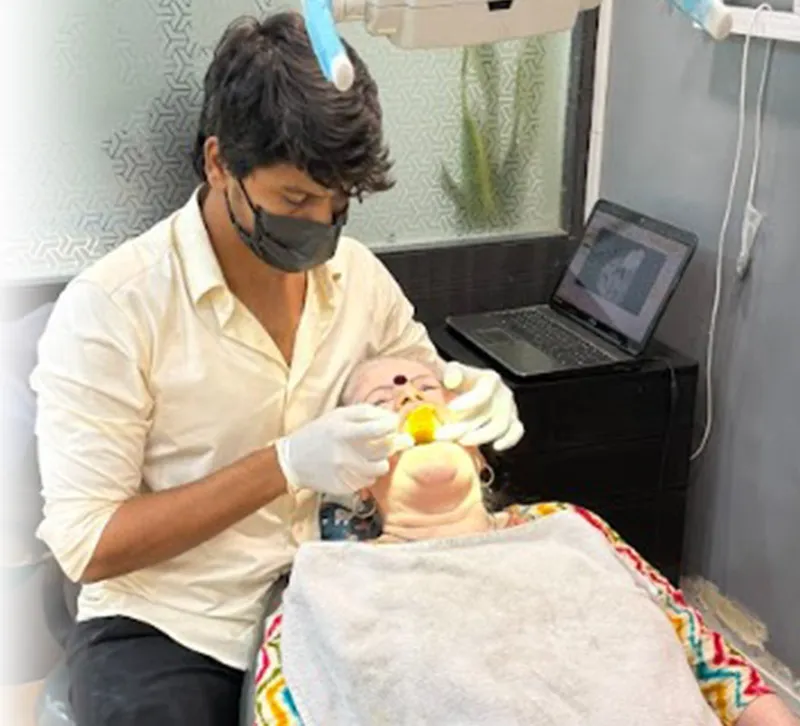
If you have been told you are a good candidate for a dental implant, you probably want to know what you are signing up for: how many visits, whether it hurts and how long it takes from start to finish. This guide walks through each stage as it usually happens. Your own plan may differ, and your dentist will explain the details for your case.
A dental implant is a small titanium post that is placed into the jawbone to support a crown, a bridge or a denture (NHS). It replaces the root of the missing tooth, which is why it stands on its own without leaning on the teeth next to it.
The stages at a glance
- 1
Examination and scan
Your dentist checks your teeth, gums and bite, asks about your health and medicines, and takes a scan to see the bone.
- 2
Planning
The implant position, size and the tooth on top are planned. You are told the number of visits, the time it will take and the full cost.
- 3
Placing the implant
A minor procedure under local anaesthetic places the implant in the jawbone.
- 4
Healing
The bone bonds with the implant over the following weeks to months. You may wear a temporary tooth in some cases.
- 5
Fitting the crown
Once the implant is firm, the connecting part and the final crown, bridge or denture are fitted.
- 6
Reviews
Check-ups to make sure the gums are healthy, the bite is right and the implant is stable.
Stage 1: examination and scan
The first visit is about whether an implant is right for you. Your dentist looks at the gap, the teeth either side and your gums. Gum disease needs treating first, because an implant depends on healthy gums around it.
You will be asked about your general health. Two things matter in particular. Large reviews have found that implants fail more often in smokers (Mustapha et al., 2022) and in people with diabetes (Al Ansari et al., 2022). Neither automatically rules an implant out, but stopping smoking and keeping blood sugar well controlled improve the odds. Tell your dentist about any medicines you take, including blood thinners.
A scan shows how much bone there is and where the nerves and sinuses sit. If the bone is too thin, a bone graft may be needed first to build the area up.
Stage 2: your plan
Using the scan, your dentist plans where the implant goes, its size, and what will sit on top. This is when you should get clear answers about the number of visits, the expected time and the full cost. If you would like to understand what affects that cost, see our guide on dental implant cost in Pune.
Stage 3: placing the implant
The area is numbed with local anaesthetic, so you are awake but should not feel pain. The gum is opened, a small space is prepared in the bone and the implant is placed. The gum is then closed, sometimes with a few stitches. For a single implant, the procedure itself is usually shorter than people expect.
If a damaged tooth is still in place, it may be possible to remove it and place the implant in the same visit. This is called an immediate implant. It saves a stage, but only suits some cases, when the bone and gums allow. Otherwise the socket is left to heal first.
Stage 4: healing
This is the longest part, and the part that cannot be rushed. Over the following weeks and months, the bone grows tightly around the implant so that it can carry chewing forces. How long your case needs depends on the bone, where in the mouth the implant is, and whether grafting was done. Your dentist will tell you.
During healing, you may have a temporary tooth, especially at the front of the mouth, so you are not left with a visible gap. You will usually have a review to check the gum is healing well.
Stage 5: fitting the crown
When the implant is firm, a connecting part (the abutment) is attached to it, and an impression or scan is taken so the crown can be made to fit your bite and match the colour of your other teeth. The final crown is then fixed in place. Replacement teeth take time to make, so this usually needs more than one visit (NHS).
Looking after an implant
An implant cannot decay, but the gum and bone around it can become inflamed if plaque is left there, in the same way gum disease affects natural teeth. Brush twice a day, clean between your teeth and around the implant with floss or small interdental brushes, and keep up your check-ups.
With good care, implants have a strong long-term record: a 2019 review of long-term studies found that about 96 in 100 implants were still in place after ten years (Howe et al., 2019). The same review found the risk was higher in people aged 65 and over, which is one more reason to keep regular reviews.
How long does the whole process take?
For most people, it is a few months from placing the implant to fitting the final crown. It can be shorter with an immediate implant, or longer if a bone graft is needed first. Most of that time is healing, not time in the dental chair. For patients coming from across Pune, that means a handful of visits spread out over the months, rather than many long appointments.
Frequently asked questions
Does getting a dental implant hurt?
+
The implant is placed under local anaesthetic, so the area is numb and you should not feel pain during the procedure. Soreness and swelling for a few days afterwards are common and are usually managed with the medicines your dentist prescribes.
How many visits does an implant take?
+
Usually several: an examination and scan, a planning visit, the procedure to place the implant, one or more reviews during healing, and visits to fit the crown. Your plan tells you the exact number before you start.
Can I get an implant on the same day my tooth is removed?
+
Sometimes. An immediate implant is placed in the same visit as the extraction when the bone and gums are suitable. Your dentist decides after examining you and your scan.
Will I have a gap while the implant heals?
+
Not always. In many cases, especially for front teeth, a temporary tooth can be worn while the implant heals. Your dentist will explain what is possible for you.
Can I get an implant if I have diabetes or smoke?
+
Often, yes, but both raise the risk of an implant failing. Keeping blood sugar well controlled and stopping smoking before and after treatment improve the chances of success. Your dentist will discuss your own risk.
Sources
- NHS: Dental treatments (bridges, dentures, implants) (accessed 13 October 2026)
- Howe, Keys & Richards (2019), Long-term (10-year) dental implant survival: systematic review and sensitivity meta-analysis, J Dent 84:9–21 (accessed 13 October 2026)
- Mustapha, Salame & Chrcanovic (2022), Smoking and dental implants: systematic review and meta-analysis, Medicina 58(1):39 (accessed 13 October 2026)
- Al Ansari, Shahwan & Chrcanovic (2022), Diabetes mellitus and dental implants: systematic review and meta-analysis, Materials (accessed 13 October 2026)
This article is general information, not a diagnosis or treatment plan. What suits you depends on an examination at the clinic, and every treatment plan and cost is explained before treatment begins.
More on dental implants · all articles